Google's NotebookLM : The Future of Smart Research

Look, I get it. Another AI tool? Really? We're all drowning in them at this point, and honestly, most feel the same. But hear me out on this one.
You know that feeling when your project stuff is everywhere? Notes here, articles there, some YouTube videos you saved for "later," random files scattered across three different folders... Yeah, that mess. That's where Google's NotebookLM comes in, and trust me, it's different.

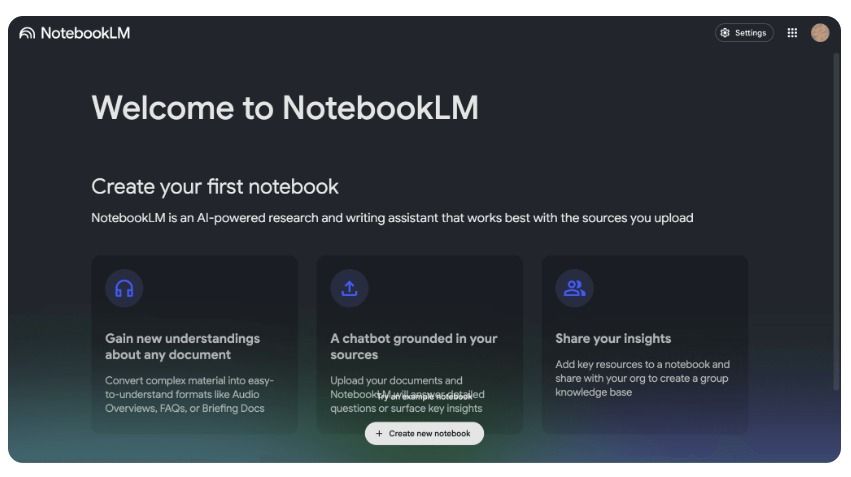
Here's the thing: NotebookLM doesn't just scrape the internet like every other AI chatbot. Instead, it focuses entirely on YOUR stuff. You feed it your documents: PDFs, Google Docs, links, even YouTube videos (as long as they have captions), and it becomes your personal research assistant. The free version lets you upload up to 50 sources. Pretty generous, right?
So let me show you five ways people are using this tool that honestly blew my mind.
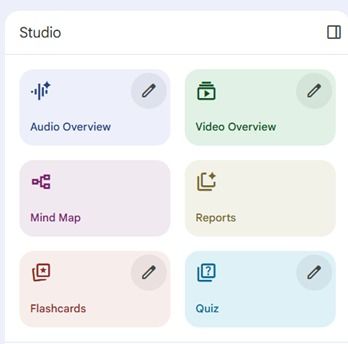
First up, you can actually make a podcast using your selected materials. We all have that pile of stuff we need to read. Research papers, training documents, entire books sitting on our desk giving us guilt trips. Finding the time? Nearly impossible. Here's where it gets wild: NotebookLM has this feature called "Audio Overview" that takes your uploaded documents and creates an actual podcast. Not some boring robot voice reading text at you. I'm talking about two AI hosts having a real conversation about your content, complete with jokes, occasional sarcasm, and natural back-and-forth. It's like they're genuinely discussing your material over coffee.

Steven Johnson, who worked on the NotebookLM team, nailed it when he said: "After waiting a few minutes for it to generate, you will have a very entertaining, kind of mind-blowing audio conversation about whatever you uploaded!" Picture this: You've got a conference tomorrow. You upload all the relevant research papers tonight, and boom. Tomorrow morning during your commute, you're listening to a personalized podcast breaking down everything you need to know. And it gets better. You can tell the AI hosts what angle to take. Got a draft you wrote? Ask them to give you constructive criticism. It's like having a feedback session in your earbuds.


The second thing that surprised me is how it helps to find the hidden story in messy project data. Okay, so every project generates tons of random stuff. Emails, notes, screenshots, random observations you jotted down at 2 AM. But turning all that chaos into a compelling story? That usually takes hours of staring at your screen wondering where to even start. This is where NotebookLM surprised me. Digital strategist Sandra Scaiano needed to create a case study, so she threw everything into a notebook: client emails, positive social media comments, rough notes, all of them. Just dumped it in there.
Then she hit that Audio Overview button, and the AI hosts automatically found the narrative thread. They took all those disconnected pieces and wove them into a story about client transformation and real results. The conversational format naturally creates a beginning, middle, and end that you can transcribe and use as your first draft. This solves something we all struggle with: people remember stories way better than they remember statistics. NotebookLM helps you find that story without spending hours trying to force it.
Third, it works as a creative partner for writers and world builders. If you're writing a novel or building a game world, you know the struggle. You've got characters, timelines, plot points, world rules, keeping it all straight while still being creative is exhausting. Here's what some writers are doing: they upload their entire manuscript, character sheets, world-building notes, everything into one notebook. Then they can ask questions like "Is Sarah's character arc actually consistent?" or "Based on what I've written, give me three plot twist ideas."
Steven Johnson calls it being able to "control F for 'interestingness'" and honestly, that's perfect. You're not just searching for facts anymore. You're searching for creative possibilities. It's like having a writing partner who's read all your notes and can help you see patterns or problems you missed. Pretty cool for a "research tool," right?
Fourth, and this is sneaky-smart, you can reverse engineering what your competitors do. Ever look at a competitor and think "How are they killing it?" Their website looks nice, for sure, but that doesn't tell you why their audience connects with them. Here's the move: Upload their content podcast episodes, popular YouTube videos, blog post into NotebookLM. Then ask it to find the patterns. "What hooks do they use to grab attention?" "What storytelling structure keeps showing up?" "What makes their content actually engaging?" You can literally prompt it with: "Find the pattern and let me know what it is."
This goes way deeper than just reading their about page. You're doing actual analysis of what works, backed by their real content. Then you can figure out how to differentiate yourself based on actual data, not guesses.
Fifth, and this is important, you need to know its quirks. Real talk: NotebookLM is powerful, but it's not perfect. And you need to know where it trips up. There was this detailed evaluation posted on Reddit that really nailed it. NotebookLM can pull information from your sources well, but it struggles with complex reasoning that connects multiple sources, math and calculations (it makes mistakes), taking specific examples and overgeneralizing them, and catching contradictions in your source material.


The Reddit post said something that stuck with me: NotebookLM can seem "brilliant and perfect" in some answers, and "completely idiotic" in others sometimes in the same conversation. So here's how to think about it: treat NotebookLM like a smart intern. Great for first drafts, brainstorming, pulling information together. But you still need to check it, especially with numbers or complex logic. Don't just trust it blindly.
Google's NotebookLM isn't just another AI chatbot you'll forget about in a week. It changes how you work with your own information. Instead of your documents just sitting there being static files, they become interactive. You can question them, explore them, have them talk to each other. The power isn't in summarizing, it's in transformation. Your research can now push back, suggest ideas, find connections you didn't see.